> ## Documentation Index
> Fetch the complete documentation index at: https://parser.xdr.ooo/llms.txt
> Use this file to discover all available pages before exploring further.
# Scenario Playbooks: choose what happened
> Find the next step based on what Auto Parser or ChatGPT showed, not the input format.
# Choose what happened after analyzing your logs
**Everyone starts in Auto Parser:** paste a few complete source events and click **Analyze Logs**. You do not have to identify a log format.
## Auto Parser: solve it inside the guided workflow
Continue to Review Fields, confirm suggested mappings, then create and download the files.
Select Problem to review, inspect the highlighted region, and try the recommended fix.
Paste examples together, review every type, and create one combined draft only when supported.
Keep all values with temporary names or enter trusted names and confirm the column order.
Correct its destination and type under Map Fields instead of rewriting extraction.
Review the message boundary, then continue only with a supported framing rule.
Compare experiments and restore a browser-local draft.
Download and use the standalone Python test sender.
## ChatGPT Assisted Parser: recover or verify a difficult case
Use the left-side **ChatGPT Assisted Parser** menu when the automatic path cannot safely interpret the source or proposes a change that needs independent checking.
Create a manually reviewed, masked prompt and paste the restricted JSON result back.
Preserve correct values and request one narrow change.
Read the error and ask for a supported structured correction.
Use other events as independent tests before approving the result.
## A real screenshot of a flagged event
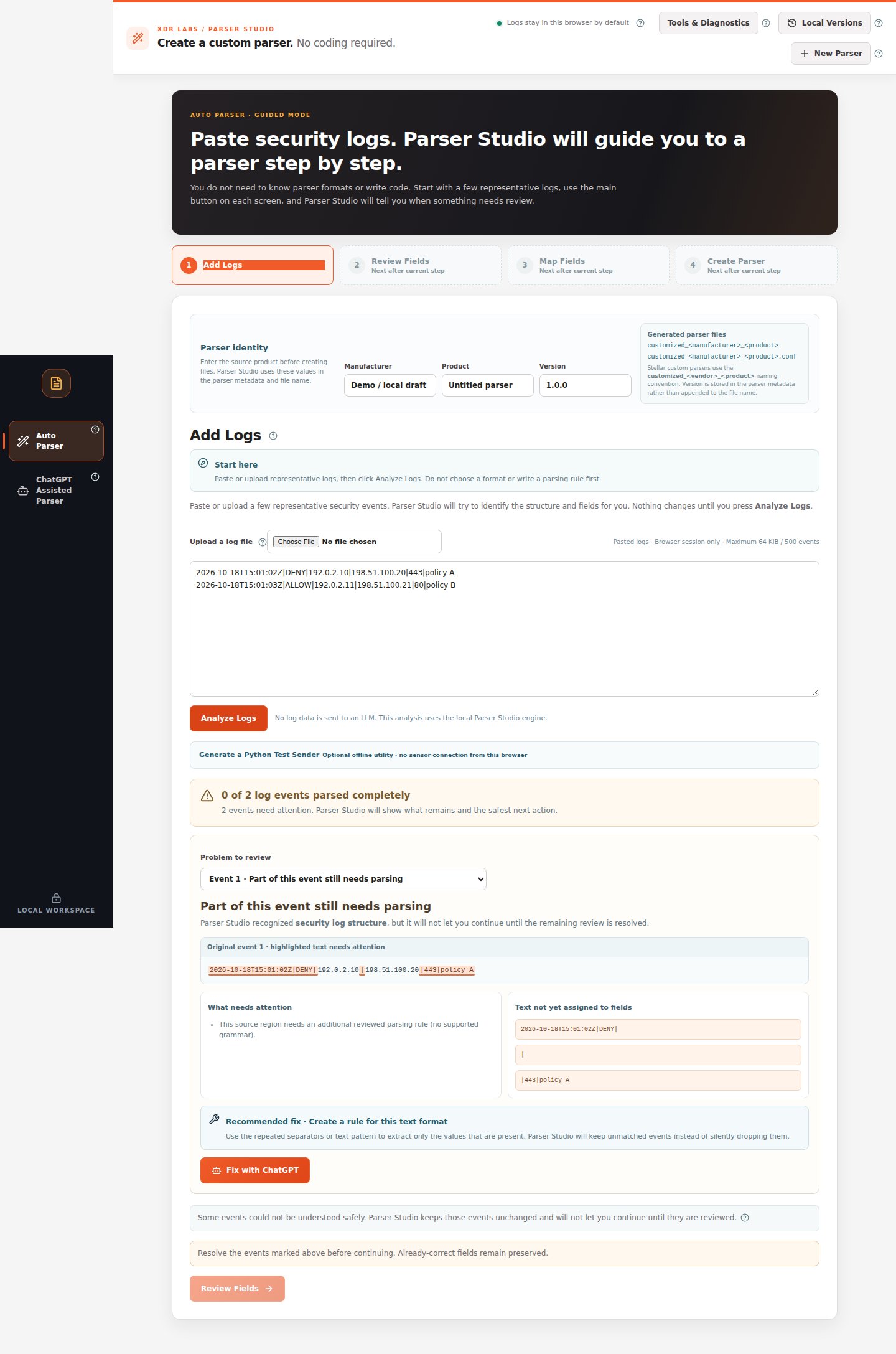 *If any events need review, the application highlights the source section instead of silently discarding it.*
## Which guide should I read first?
* [Everything parsed correctly → finish the four steps](/quickstart)
* [Some text is highlighted → repair only the affected part](/scenarios/partial-event)
* [Completely unfamiliar logs → ChatGPT Assisted Parser](/scenarios/unknown-log)
* [One product, many event types → review a combined parser](/scenarios/mixed-events)
All images were captured from the real Parser Studio interface using fictional data. No extra parser mode is required.
This documentation is built and hosted on [Mintlify](https://mintlify.com), a developer documentation platform.
*If any events need review, the application highlights the source section instead of silently discarding it.*
## Which guide should I read first?
* [Everything parsed correctly → finish the four steps](/quickstart)
* [Some text is highlighted → repair only the affected part](/scenarios/partial-event)
* [Completely unfamiliar logs → ChatGPT Assisted Parser](/scenarios/unknown-log)
* [One product, many event types → review a combined parser](/scenarios/mixed-events)
All images were captured from the real Parser Studio interface using fictional data. No extra parser mode is required.
This documentation is built and hosted on [Mintlify](https://mintlify.com), a developer documentation platform.